
LUXEMBOURG LIFE INSURANCE
Is Luxembourg life insurance
right for you?
You may be looking for a wider choice of investments or a policy you can keep after moving abroad. Let's check what a Luxembourg policy would add, what it costs and what protection it provides.
A Luxembourg policy will not suit every situation.
4 questions · No contact details · Immediate result
Book with Gary · 40 minutes 5,0/5 on Google
Private advice · Your priorities first
Are the costs and restrictions worthwhile for you?
-
What would it add?
Check whether the investment options and policy terms would help with your plans, a move abroad or your inheritance wishes.
-
Do the fees make sense?
Compare the fees and restrictions with the services you actually need, before moving your money.
-
What protection do you have?
Legal protection and investment risk are different things. The Luxembourg framework does not guarantee the value of your investments.
Before a large payment or a policy withdrawal, review the reasons for the change, its costs and its consequences.
QUICK QUESTIONNAIRE
Four questions to understand your needs
These questions do not collect personal details. They help prepare a conversation with Gary.
4 questions · No contact details · Immediate result
RESULT
I'd prefer a call back → 5,0/5 on GoogleYour situation deserves a more precise analysis
Your context
The priority points to be checked
What we could discuss
Linking these elements to your situation helps clarify the points to be checked before any decision is made. This mini-diagnosis is neither a recommendation nor an automatic validation.
Does this policy fit your situation?

QUESTIONS TO CONSIDER
Your circumstances
Tax status and residence
Key point
The country of the contract never replaces the analysis of your tax residence.
Points to be checked
- Check your current tax residence, the destination country and the relevant treaty.
- Identify reporting obligations before taking out the policy.
- Avoid a decision based solely on the prestige of Luxembourg.
Asset protection
Key point
The Luxembourg framework provides asset separation and supervision. It does not guarantee their value.
Points to be checked
- Understand the roles of the insurer, custodian and CAA.
- Distinguish legal protection from market risk.
- Compare with your existing policies and accounts before changing arrangements.
Access to investment
Key point
Available investments depend on the policy, the insurer and the applicable classification.
Points to be checked
- Check which investments are actually available.
- Distinguish external funds, FID, FAS and internal collective funds.
- Check the policy documents before assuming an investment is available.
Inheritance planning
Key point
The beneficiary clause and the countries where the people involved live affect the analysis.
Points to be checked
- Check where the policyholder and beneficiaries live.
- Coordinate contract, civil law and family goals.
- Do not use Luxembourg as a universal inheritance shortcut.
Lombard lending and liquidity
Key point
A policy that can be pledged does not mean a loan has been approved.
Points to be checked
- Check the lender's position before taking out a policy with borrowing in mind.
- Check eligible investments, pledge clauses and restrictions on investment switches.
- Anticipate the consequences of a fall in the value of assets.
Moving between countries
Key point
A policy that suits you today may no longer suit you after a move abroad or a return.
Points to be checked
- Set out the dates of your changes in residence.
- Check the rules in the country you leave, your destination and on your return.
- Avoid withdrawals or investment switches while your tax situation is unclear.

03 — What protects your assets?
Understand the protection
before discussing safety
Luxembourg's reputation is reassuring, but the protection depends on the policy structure, the regulatory separation of assets and supervisory arrangements.
Contract
The policy sets out its terms,
structure and permitted transactions.
Representative assets
Identified assets set aside separately from the insurer's own assets.
Supervisory framework
Supervision by the CAA and a regulatory framework that protects policyholders.
What the framework provides
- Separation of representative assets
- Prudential supervision by the CAA
- Separate assets held for policyholders
What it doesn't guarantee
- A policy that suits everyone
- Automatically optimal taxation
- A Lombard loan automatically granted
The separation of assets does not remove market risk. Value, liquidity and taxation are not guaranteed.
Read the official CAA framework (new tab)POLICYHOLDER CLASSIFICATION
Which CAA category corresponds to your situation?
The Commissariat aux Assurances classifies policyholders using the amount invested with the insurer and the financial wealth declared when the policy is taken out.
Default category. No threshold specific to this category
Level A Amount invested and financial wealth
Level B Amount invested and financial wealth
Level C Amount invested and financial wealth
Level D Amount invested and financial wealth
The CAA classification is neither an agreement nor a promise of financing; a possible credit is a matter of the lender's analysis and policy.
Investment policies proposed by the insurer may be more restrictive than regulatory maxima.
See Circular CAA 26/1When might this policy be worth considering?
IS IT SUITABLE?
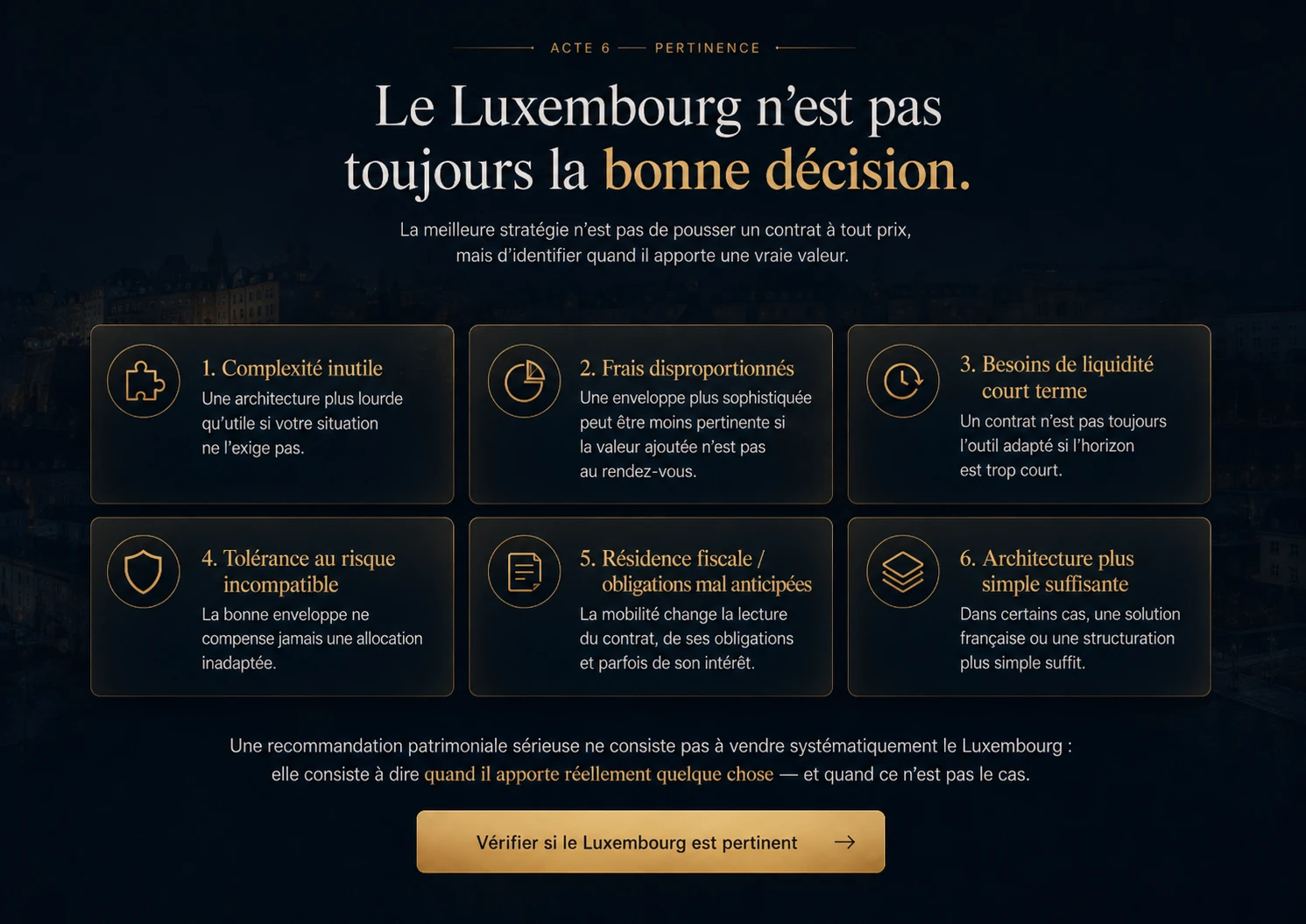
In which cases do the constraints exceed the advantages?
Unnecessary complexity
Key point
A sophisticated structure remains a bad solution if the need is simple.
Points to be checked
- Compare what the policy adds with a simpler account or policy.
- Identify what the structure really needs to improve.
Disproportional costs
Key point
The total cost should be justified by a specific wealth planning need.
Points to be checked
- Check fees at both policy and investment level.
- Check that the expected benefit justifies the complexity.
Short-term liquidity
Key point
Money you need soon should not be tied up in an unsuitable arrangement.
Points to be checked
- Clarify the horizon of capital.
- Keep accessible reserves outside your long-term investments if needed.
Incompatible risk
Key point
The Luxembourg framework does not remove the risks of the underlying investments.
Points to be checked
- Consider how much of a fall in value you could accept.
- Review currency exposure, concentration, liquidity and investment horizon.
A change of tax residence not planned for
Key point
Treatment depends on the country of residence and chronology.
Points to be checked
- Document the country of current and future residence.
- Check reporting obligations before acting.
Simpler alternative
Key point
A solution already available can sometimes respond to the need without changing the frame.
Points to be checked
- Compare your existing accounts and policies.
- Choose Luxembourg only when it addresses a specific need.
What changes when you live abroad?

MOVING BETWEEN COUNTRIES
Will your policy still suit you after a move?
Check the terms of the contract and the rules of the country where you will live before making a decision.
France
What changes
For a French resident, the contract remains to be read with the French rules and the applicable reporting obligations.
What to check
- Check reporting requirements for policies held outside France.
- Compare with the policies and accounts already available in France.
Departure
What changes
The actual date of the change of residence is a critical point.
What to check
- Clarify the fiscal timeline.
- Avoid taking out or cashing in a policy while your transitional tax situation is unclear.
Living abroad
What changes
The country of residence may change obligations, taxation and possible operations.
What to check
- Verify the local acceptance of the contract.
- Update your residence, address and any operational restrictions.
Return to France
What changes
Before reorganising your finances on your return, review the entire policy.
What to check
- Verify the order of operations.
- Keep the relevant supporting documents and meet reporting requirements.
Can it secure a Lombard loan?

Lombard loan
Can your contract be used as a guarantee for a credit?
Opening a contract does not guarantee your financing.
Opening a contract does not guarantee your financing. Each lender applies its own criteria.
Contract
What the lender analyzes
The lender examines the type of policy, the insurer and the pledge clauses.
What can block and what to check before
- Validate acceptance of the contract by the lender before subscribing.
- Identify restrictions on withdrawals and investment switches.
Eligible assets
What the lender analyzes
The lender may treat different investments differently as collateral.
What can block and what to check before
- Verify liquidity, currency, concentration and valuation.
- Ask the lender for its asset eligibility criteria.
The lender's assessment
What the lender analyzes
The lender retains its own risk policy.
What can block and what to check before
- Your country of residence and the intended use of the funds may matter.
- No CAA category constitutes loan approval.
Conditions
What the lender analyzes
Pledging the policy changes how you can manage it in future.
What can block and what to check before
- Review the terms, ongoing obligations and margin thresholds.
- Anticipate the consequences in the event of a decline in assets.
Financing
What the lender analyzes
The purpose of the loan should fit your financial plans and timescale.
What can block and what to check before
- Check how long setting up the loan will take.
- Do not commit to the transaction until the lender has accepted the collateral in writing.
YOUR QUESTIONS
Still weighing up your options? Answers to common questions
What is Luxembourg life insurance?
A life insurance policy issued by an insurance company established in Luxembourg and subject to prudential supervision by the Commissariat aux Assurances (CAA).
Is it safer than French life insurance?
The comparison needs to be precise: Luxembourg provides asset separation and supervision, but does not guarantee the value of the investments or prevent losses.
What is the security triangle?
It describes the relationship between the insurer, the custodian and the supervisory authority. It is a supervisory arrangement, not a capital guarantee.
What are the benefits for a non-resident?
For a non-resident, the potential interest lies in the ability of the contract to be used in an international context and its investment architecture. However, taxation, reporting obligations and even acceptance of the contract depend on the country of residence, the insurer and the situation of the subscriber. The relevance must therefore be verified country by country.
How much does it take to open a contract?
CAA categories and commercial minimums are different. The minimum investment depends on the insurer and policy, and may be more restrictive.
How does CAA categories work?
CAA categories classify policyholders using the amount invested with the insurer and their declared financial wealth. They define the regulatory framework for access to certain investments, not a level of protection or loan approval.
Is Lombard loan automatic?
No. Each lender applies its own policy and analysis of the contract, assets, residence and use of funds.
What costs should be anticipated?
Fees depend on the policy, investments, management approach and services. A reliable amount requires a contractual proposal.
Should we declare the contract in France?
For a French tax resident, a policy held outside France may carry specific reporting obligations. These need to be checked for the individual case.
When is Luxembourg not relevant?
When your needs do not justify the complexity, you need the money in the short term or a simpler account or policy already meets your needs.
Sources and limits of this information
CAA category information comes from the official publications of the Commissariat aux Assurances. It is general information, not a substitute for reviewing your policy, residence, objectives and the applicable rules.

Directly with Gary
Have a question about your investments or your situation?
Reviewing a policy, investing cash, selling a business or moving abroad? Let's discuss it in a 40-minute meeting. I will help you identify what needs to be considered before you commit.
- Confidential, with no obligation
- 40 minutes · Video call